
Year 4 maths this term: what to practise before the June times tables check
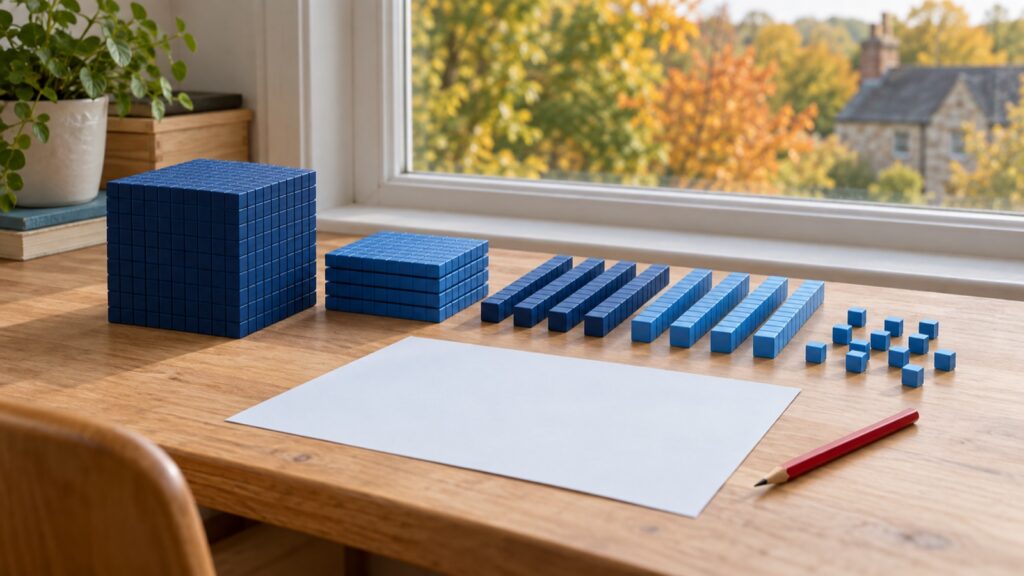
Year 4 is the year the numbers get longer. Your child moves from hundreds into thousands, meets written methods for all four operations, and is expected to know every times table up to 12 by the summer. This guide shows what the autumn term covers, what the June check is, and what ten minutes a day should look like.
What Year 4 maths covers this term
The England Year 4 maths page lists the lessons in teaching order. The autumn term is mostly number:
- Place value. Numbers from 100 up to 9,999, then five digits. What each digit is worth.
- Addition and subtraction. Three and four digit numbers, written in columns, including subtraction that needs borrowing.
- Multiplication. A written method, and multiplying by 10 and 100.
- Division. Sharing, known facts, and answers with a remainder.
- Fractions. Comparing fractions, adding fractions with the same denominator, and equivalent fractions.
- Decimals. A first look at tenths and hundredths.
Time, measures, angles and shape are on the same page. They come later in the year. There is no need to reach them in the autumn.
The times tables check in June: the facts
Year 4 pupils in state schools in England take the multiplication tables check in June. Here is what it is.
- It is done on a screen, at school.
- There are 25 questions.
- Your child has 6 seconds to answer each one.
- The questions cover the tables up to 12 times 12.
The government’s own note to parents says you do not need to do anything extra to prepare. Read it here: Multiplication tables check: information for parents.
Six seconds is short. It means the facts must be known, not worked out. That is the reason to start in the autumn and not in May.
A ten-minute tables routine
Learn the tables in the order school teaches them.
| Half term | Tables | Why this order |
|---|---|---|
| Autumn 1 | 2, 5, 10, then 3 and 4 | These are from Year 2 and Year 3. Check they are still quick. |
| Autumn 2 | 8, then 6 | 8 is double 4. 6 is double 3. |
| Spring 1 | 7 and 9 | The two that take longest. |
| Spring 2 | 11 and 12 | 12 is 10 plus 2. |
| Summer 1 | Mixed questions | Any table, any order, against a timer. |
Each sitting is the same:
- Say one table out loud, in order.
- Ask ten questions from that table, out of order.
- Write down the facts that did not come straight away.
- Start the next sitting with those facts.
Stop at ten minutes. A calm ten minutes every day is worth more than an hour on Sunday.
Worked example 1: place value
This is the idea from the lesson on the numbers 1000 to 9999.
Write 4,305 in thousands, hundreds, tens and ones.
4,305 is 4 thousands, 3 hundreds, 0 tens and 5 ones.
The zero still has a column. If it is left out, a child often writes 435. Say the columns out loud, then write the number again.
Worked example 2: subtraction with borrowing
Work out 502 − 178.
There are not enough ones, and there are no tens to borrow. Borrow from the hundreds first. 5 hundreds becomes 4 hundreds and 10 tens. Then 10 tens becomes 9 tens and 10 ones.
Ones: 12 − 8 = 4. Tens: 9 − 7 = 2. Hundreds: 4 − 1 = 3. The answer is 324.
Check it with addition. 324 + 178 = 502. A child who checks this way finds their own mistakes.
Worked example 3: fractions with the same denominator
Add 1/5 and 2/5.
The pieces are the same size, so add the tops only. 1/5 plus 2/5 is 3/5.
Do not add the fives. Five tells you the size of the piece.
Five questions to try
Cover the answers. One sitting is enough.
- Write 6,048 in words.
- 3,275 + 1,468
- 7 × 8
- 47 ÷ 5
- Which is bigger, 3/8 or 5/8?
Answers
- Six thousand and forty-eight.
- 4,743
- 56
- 9 remainder 2
- 5/8. The pieces are the same size and there are more of them.
What the wrong answers tell you
- 648 for question 1. The zero was dropped. Go back to the place value lessons.
- 4,733 or 4,643 for question 2. A carried digit was forgotten. Write the carried digit small, under the line, every time.
- A long pause on question 3. The fact is being worked out, not remembered. Put 7 × 8 on the list for the next tables sitting.
- 9 for question 4. The remainder was left off. Ask “how many are left over?”
This week
Open the Year 4 maths page and do the first three number lessons. Each lesson is a short video, then the questions that go with it. Your child can pause the video and try the step again.
If a question is too big, use a smaller number from the same lesson. 305 uses the same columns as 4,305. Stay on that lesson until the columns are right, then move down the list.
The other year groups are on Maths. What the programme includes is on the pricing page.